
Your guide to the Mistborn Handbook in the Cosmere RPG
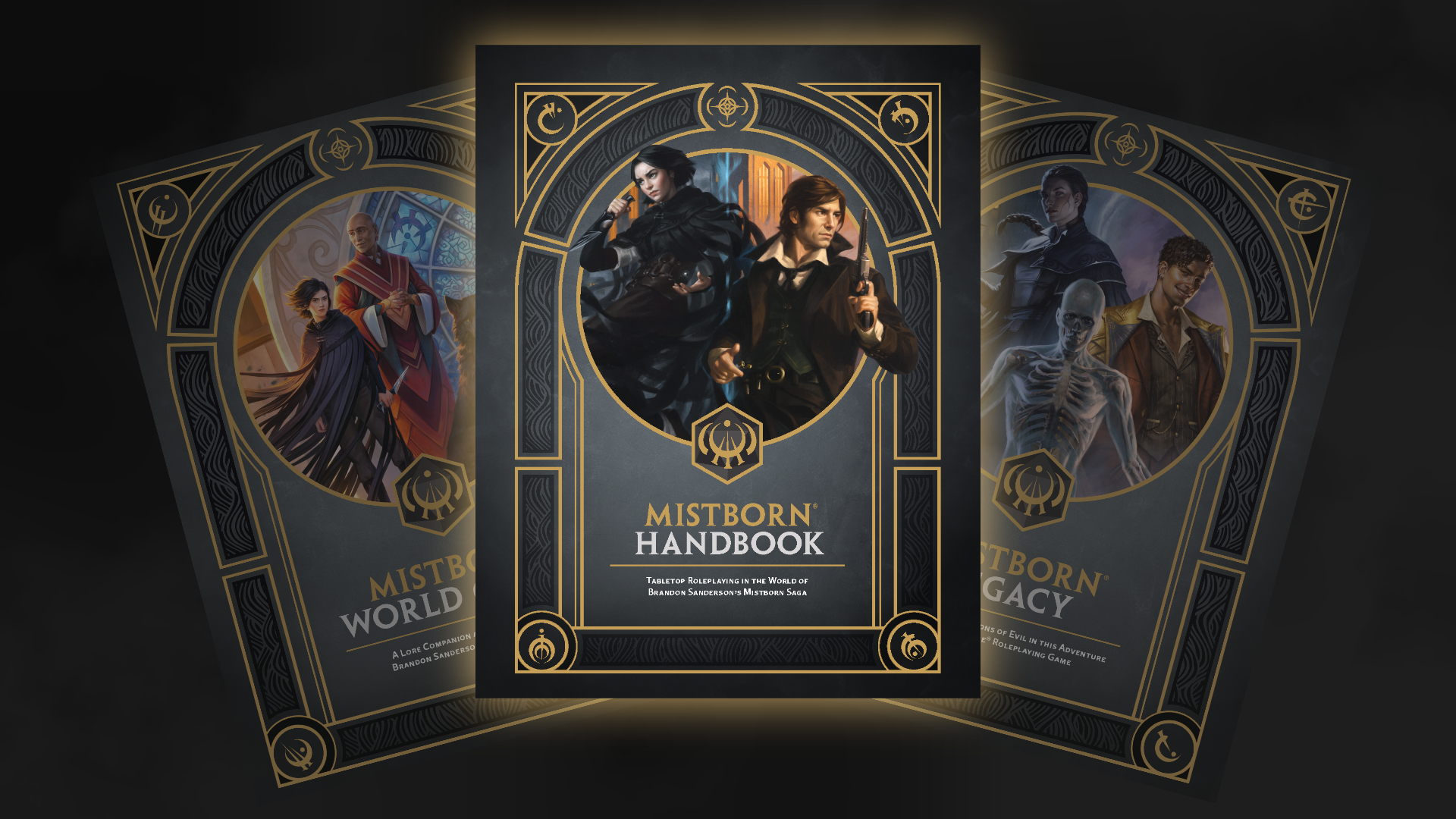
In this article we are going to break down what's included in the Handbook chapter by chapter.
If you are brand new to the Cosmere RPG, I will be going over the basics of what information is included in each chapter, for your reference. If you are returning from the Stormlight setting, I will be noting the areas where the Mistborn Handbook expands upon the rulesets we already have.
There won't be any spoilers for Mistborn Legacy, the first major campaign release for the Mistborn setting, but know that spoilers for the Mistborn books, both Era 1 and 2, are inevitable.
If you haven't completed your journey through all Mistborn books released to date, know that there may be detail or two revealed when talking about Mistborn setting in the RPG. If you are sensitive to spoilers, I would advise not diving in to these books until you've fully enjoyed them in their entirety.
You have been warned.
I want to take a moment to thank Brotherwise Games for the opportunity to get these videos ready for kickstarter release.
For full transparency, while I did fully back the kickstarter on my own dime, the PDF sourcebooks were sent to me early so that I could get these videos ready for release.
Brotherwise doesn't have any control over the content itself, and doesn't review my content prior to their release. That means I can totally trash them for their Atium pricing guidance, should I see fit.
One last thing before we dive in to the book - this won't be a full reveal of the contents of the book. I won't be diving in to each new path, tree, and talent, released for the Mistborn setting. On a similar note, this won't be a guide for now to play or gamemaster the Cosmere RPG. Think of this more as a sampling platter to let you know what you're getting in to when buying the book, and help point out the areas that you'll want to dive in to in depth.
There will be times where I do dive in to a little detail where it helps contextualize why a particular section is important, but for the most part, expect a brief overview. If I have deeper dive video already released, I'll be sure to note it and leave links in the description below.
One last piece of housekeeping.
This article will be broken up in to sections for each chapter in the book, use the timestamps in the description to find where you want to go next.
If you are just as Invested in the Cosmere as I am, be sure to subscribe to my YouTube channel and subscribe to my newsletter.
If you want to listen to this article instead of reading it, check out the complete video YouTube:
With all of that out of the way, let's dive in to the book.
Introduction

First up is the introduction.
This is a quick overview of the contents of the book, but it has a few important details for new players, and those not familiar with the Mistborn setting. There is a basic overview of the storyline that takes us from Era 1 to Era 2.
Its a broad overview that lays out the Lord Ruler's ascent to power, and his eventual downfall. It brings a zoomed out view of the story and includes details about the shards, and some of the major plot points explored in Era 2.
This general overview is important context for anyone looking to play in the Mistborn setting, since Mistborn Legacy, and really, the way Brotherwise has structured this setting, all revolves around both Era 1 and 2 of Mistborn.
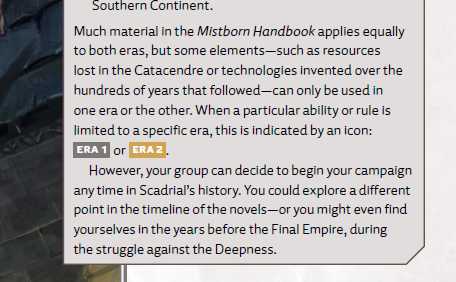
Eras of Play Symbols used in the Mistborn Handbook and Worldguide
This is also where the "Eras of Play" mechanic is explained. This is a visual identification used when a specific element of gameplay is locked to a specific Era.
We'll look at some examples as we explore deeper through the book.
From here we see a lot of basic information like the basics of Roleplaying Games, the flow of the Cosmere RPG, actions, rolling dice. Most important for new players and gamemasters to the Cosmere RPG is the section on the Plot Dice and the Opportunities and Complications system.
This is one of the most unique aspects to the Cosmere RPG and plays a significant role in all forms of gameplay. The plot die is a 6 sided die that you can optionally role alongside a skill test that has big stakes.
Two sides of the die are blank, and lead to no extra effects.
Two sides of the die are opportunities, which grants unexpected positive narrative results, and some in game benefits.
Two sides of the die are complications, and are also marked with either a 2 or a 4.
The opposite to an opportunity, a complication will have a negative narrative effect, and may also cost some resources. As a salve to the downturn of luck, the 2 or 4 gets added to the skill test that was rolled, increasing the likelihood that the test will pass.
This section is well suited for both new players and gamemasters.
Those who played through the Cosmere RPG in the Stormlight setting can skim this as long as you feel comfortable with the Eras of Play mechanic.
Chapter 1: Character Creation
Chapter 1 is all about creating player characters. This chapter is a step-by-step guide to creating a player character in the Cosmere RPG.
This will take through choosing your characters origins, picking your first path, and building your characters stats, story and equipment.
For new players, this is a basic overview of the character building process.
Details of the specific ancestries, attributes, skills, and paths at your disposal will come in later chapters. Do pay close attention to the section on your character sheet, since that will be how you record all of the details about your player character going forward.
Those familiar with the Stormlight setting will want to pay particular attention to how the Era of Play for your campaign affects the paths and specialties available to your player character.
For example, in Era 1 you can choose to play a Feruchemist or a Mistborn as a metalborn path, but those options aren't available to players in Era 2.
Similarly, Era 2 allows for Ferrings and Twinborns, which are unavailable in Era 1.
Something to keep in mind here is that these restrictions are to keep your campaign Canon, which means you can absolutely ignore it if you want to.
If you want to learn more about the character creation process, I have two videos on my channel already you can check out:
Both are set in the Stormlight setting, but the basics are relatively the same for Mistborn. If you're using a virtual tabletop system or campaign manager like Demiplane, The character creation process is streamlined through a series of easy to use menus.
A final important section of chapter 1 is character advancement, concept crucial for both gamemasters and players to understand when planning a long-term campaign.
On page 29, there is a character advancement table that shows everything that happens when you level up.
This also introduces another important Cosmere RPG mechanic: Tiers of Play. Tiers of Play affect the type of adversaries you'll be squaring off against throughout your adventure, and is a core concept of building combat encounters which will discuss later in a later chapter.
Chapter 2: Origins
Chapter 2 covers your player characters origin.
There are three races or ancestries available in the Mistborn setting: Human, Kandra and Koloss Blooded. Each playable ancestry has its own unique perks.
Similar to playing a Singer in the Stormlight setting, Kandra and Koloss Blooded ancestries have their own talent tree that provides unique bonuses in exchange for depth in heroic and invested paths.
For new Cosmere RPG players, you'll learn more about talents in the heroic and Metalborn paths chapters later on, but basically this means you get additional talents and abilities because of your ancestry, but must balancing leveling them up over your other paths. Along with each playable ancestry is detailed information about their culture and roleplaying tips.
Once again, the Era of Play for your campaign is a major factor in choosing your character's culture and roleplaying. It wouldn't make much sense to play a Luthadel Nobleman in Era 2, just like it wouldn't make sense being a street car driver from Elendel in Era 1.
This chapter is an important resource for both new and veteran players and gamemasters.
A note on lore here, the details on offer are the type of information that a player character would reasonably already know about the world around them and their culture.
Gamemasters who want more in-depth information about the secrets of Scadrial and its cultures should dive into the Mistborn Worldguide.
Chapter 3: Character Statistics
Chapter 3 is all about your player character's statistics.
These are the numeric values that define the capabilities of your player character. Everything from how how much weight they can carry to how far they can see has a stat connected to it and an explanation in this section.
Understanding the numbers that drive player characters is something important for both gamemasters and players to know well, but it can be a bit number crunchy.
Even veteran tabletop roleplaying folks who are new to the Cosmere RPG will want to spend some time studying the player character stats.
The Cosmere RPG introduces some unique values, like Investiture that are specific to the game.
If you're coming over from Stormlight, there's not too much different about attributes in Mistborn, but it's always good to have a reminder.
Another core concept in this section is Expertise.
These are categories of information that your characters know extensively. If this is your first time playing the Cosmere RPG, think of expertise as a set of knowledge you know well. This could be specific information you've been trained in, or learned in school.
It could also be things you understand from the world around you, like your culture and language.
While there are some defined expertise that grant the ability to use or craft certain items, the system is fairly open to interpretation. While the fine details are up to the gamemaster, having expertise in something allows for you as the player character to simply know certain bits of information, or be able to roll to understand complex ideas related to the topic.
For example, someone with laboratory expertise would be able to walk into Wax's Home lab and get an understanding for the type of equipment he's using and what general safety procedures you should take before using it.
You would be able to roll deduction or insight checks to get an understanding for what he might have been working on.
Someone without this expertise wouldn't be able to make heads or tails of it, and even with a successful skill test, wouldn't gain much information through observation alone.
Another core piece of Cosmere RPG player characters explained in this section are the health focus and investiture stats. If you're familiar with other types of tabletop RPGs, health is about what you would expect it to be.
Focus and Investiture however, are two key mechanics worth exploring for both new players and gamemasters. Focus basically works like spell slots do in dungeons & dragons, but cover a wide variety of abilities and maneuvers that all players have access to. Focus also ties in deeply with many talents, so it's an important concept to learn.
I have an in-depth video on focus on the channel;, but know that it doesn't cover any of the Mistborn setting specific talents, so your mileage may vary.
Investiture is the stat that anybody who plans on playing and Allomancer or Feruchemist will need to understand.
Finally, this chapter covers skill tests. Yeah, this is a massive chapter.
Skills are the measures of how well your player character or NPC is at completing an action.
Need to roll out of the way of a charging horse? Roll an agility skill test.
Need to lie your way out of a tricky situation? Test deception.
Planning on attacking with the dagger you have strapped in your pant leg, roll a light weaponry skill test. Almost every action in the Cosmere RPG eventually breaks down into a skill test, and what skills your character has defines what they're capable of doing in game.
Having an in-depth knowledge of skills is incredibly valuable information for everybody, but is particularly important for the gamemaster. You need to be able to interpret your players desired actions into a relevant skill test quickly and consistently to ensure a well-paced session. There is nothing worse than when a player builds their character around having a specific set of skills only to discover that their gamemaster would interpret their actions with a different skill test.
Use this as a general reminder for both players and gamemasters to chat during the character creation process to make sure everybody's on the same page.
There's also specific guidance on how to resolve skill tests that get in to the nitty gritty of in-game scenarios. Things like attempting to try again after a failed roll, how to handle players helping each other, and integrating Opportunities and Complications in to skill tests.
Even though a lot of this advice is gamemaster forward, its still important for players to have a passing knowledge of so they can know what to expect when rolling the dice.
Chapter 4: Heroic Paths
Heroic paths are the building blocks that make up your player characters capabilities and playstyle. If you're new to the Cosmere RPG, think of these as your class or profession that you might see in games like Dungeons and Dragons or Pathfinder.
In this section of the book we'll learn about each Heroic Path's playstyle, get details on their talents, and get inspiration from similar characters in the Mistborn books.
Those coming from the Stormlight setting will note some similarities: all the heroic paths from Stormlight are here in Mistborn.
Agent, Envoy, Hunter, Leader, Scholar, and Warrior.
Where things are unique for this setting comes from the specializations under each path. While some talents and trees are similarly named, the details here are all Scadrial in their flavor.
For example, the Hunter Path in Stormlight saw specializations in Archer, Assassin and Tracker. The Hunter Path in Mistborn is different, giving you specializations in being a Hazekiller and Sharpshooter, while Tracker is the same.
Heroic Paths are another area where Eras of Play must be considered. Certain specializations are only available in specific Eras. There are no guns in Era 1, so taking the Gunslinger specialization in the Warrior Path doesn't make much sense.
Something that I find particularly helpful in this section are the roleplaying recommendations. These are character archetype that a player choosing this Heroic Path might consider.
For example, the Agent Path gives a recommendation of playing a Ghostblood Initiate, giving you role playing ideas, recommendations for expertise, and suggestions on which skills to pick.
These aren't hard and fast rules, more inspiration to get you started. Heroic Paths are an essential part of the character building experience. Knowing what Paths and Talents you want to build towards affects the attributes and skills you should focus on when building your player character.
Heroic Paths are particularly important given the way the new Metalborn Paths work, which is we'll take a look at right now.
Chapter 5: Metalborn Paths
Metalborn Paths are where we will find the namesake of this setting.
If you want to play a Mistborn in the Mistborn RPG, this is your chapter. If you're coming over from the Stormlight setting, Metalborn Paths are the equivalent to the Radiant Paths from the Stormlight Archive. If you're new to the Cosmere RPG, these specialty paths grant talents and skills that make use of Investiture, the magic of the Cosmere.
There are 5 Metalborn Paths in the Mistborn setting:
Misting, Mistborn, Feruchemist, Ferring, and Twinborn.
Mistings are available in any Era of Play, while Mistborn and Feruchemists are locked to Era 1 and Ferrings and Twinborn are locked to Era 2. There are also similar restrictions for your ancestry.
Again, these restrictions are just to keep things canon. At my table, I would allow someone to play a Twinborn in Era 1. I like having the option, and so long as its not to take advantage of some weird exploit, I'm good.
If you're not up to speed on your Mistborn lore, these different Metalborn Paths define both how many metallic arts you have access to, and how you use them.
For example, a Misting can burn one type of Metal, while a Mistborn can burn all of them. If this makes you think that taking Mistborn is always the right play, you would be wrong.
Talents are a scarce resource is the Cosmere RPG, and if you want a well rounded character, you'll be balancing your allocation across your chosen Heroic and Metalborn Paths as well as potentially those from your ancestry. Only having to focus on one or two Metallic Arts means that you'll gain mastery of them faster than someone who can dabble in many.
If this sounds familiar, this is the exact same reason Kelsier sent Vin to train with the Mistings of the crew in the Final Empire.
There is a lot to dive in to in this chapter. Allomancers and Feruchemsits have different rulesets for growing and managing their skills. Allomancers need to focus on training their abilities through Goals, manage their metal reserves, and gain an understanding of metal purity. Feruchemists have to learn about the use, creation, and maintenance of Metalminds.
For each Metalborn path, you get a few key pieces of information to help you build your character. Like Heroic Paths, each Metalborn Path has example characters from the books giving you roleplaying inspiration.
Each Metalborn path also has a talent tree of its own to explore. If you're coming over from the Stormlight Setting, you know that Radiant Paths were locked in to specific surges based on your Order.
Unique to the Mistborn setting, choosing a Metalborn path allows you to choose your Metallic Arts. These are the specific powers your character has access to, and are covered in depth in the next chapter.
There are two ways you can go about determining what metals you have access to: you can make the choice for yourself, or the Handbook has handy tables where you can roll to randomly select your Metallic Arts.
Before we move on to the Metallic Arts, I want to point out one major aspects from Metalborn Paths that those coming from the Stormlight Setting will want to note.
Taking a Metalborn path can be done at character creation, from level 1.
In the Stormlight setting, you had to choose a Heroic Path first, then take a Radiant path later on. In the Mistborn setting, you can start as an Allomancer or Feruchemist if you want.
There's a lot more to discuss on that topic, but for now let's head in to the next chapter: Metallic Arts.
Chapter 6: Metallic Arts
Before we dive in to the deep here, I want to address new players and gamemasters to the Cosmere RPG, especially if you are unfamiliar with Mistborn lore.
Metals and the Metallic Arts are the way the magic in this setting works. Different metals have different abilities that they imbue.
This can get incredibly complicated, and in this section of the book, you're going to see all sorts of charts and graphs aligning metals and their associations.
Certain metals are only available in certain Eras.
It's a lot.
In fact, each Metal could probably use its own video, and when you start pair metals and combining their abilities... the possibilities feel endless.
A word of general advice no matter if you're a Cosmere RPG veteran or not. Gamemasters and players should talk about use of metals to get a shared understanding of how they might work together.
There are some incredible opportunities to make fun and flashy combinations, someone which will require deep planning of talents and character builds.
Save yourself a headache and argument at the table by chatting together before your plans sink in.
Ok, with that out the way, there are 34 metallic arts, plus hemalurgy in the Mistborn setting.
Each Metal has a specific tree for Allomancy and Feruchemy. That's a lot, but the trees are relatively small.
Some metallic arts like Duralumin allomancy only have two talents.
Others have 6 or even 7 talents.
What's interesting here is that completing your Investiture-based talents is alot more varied than Radiant Paths from the Stormlight setting. Almost all Radiant paths are about 25 talents in total to complete, including your key talent. The Mistborn path has 7 base talents, and an additional 56 talents to master all of the metals available in Era 1. If you want to be technical and include Duralumin and Electrum in to the mix, that brings your grand total up to 71.
That's going to take some time.
Compare that to a Pewter Misting who has just 6 Metalborn Path Talents, and 6 Metallic Arts Talents, and you're done after just 12 talents.
The specifics of Metallic Arts needs its own separate video, but I'll summarize with this: Compared to the Radiant Paths of the Stormlight setting, Mistborn introduces a lot more flexibility and player choice around building an invested character.
Metalborn paths that only take advantage of one metal can also grow their talents in Heroic Paths without sacrificing their depth in their single metallic art.
At Nexus last year, Brotherwise noted that this led to many play testers to opt to play Mistings and Ferrings over full Mistborn or Feruchemists.
I think its a really interesting design for the RPG.
In the Stormlight setting, it seemed like many players felt that they needed to build in to a Radiant Order to get the most out of the game. I personally disagree with that idea, but I can understand why someone would feel that way: its a unique aspect to the world of Roshar and central to the story.
It makes sense to work towards a Radiant path. The design in Mistborn makes it so that playing a full Mistborn or Feruchemist isn't a given. Other paths are just as viable, and one could argue, essential depending on the scope of the campaign you're playing.
A key aspect to understand about early game metal use is Nacent Powers.
Before you are trained in your Metallic Art, you have access to nacent powers, which are representative of your untrained skill in that metal.
Think Vin passively soothing people before she understood her powers.
The rules here are fairly light, and subject to creative uses and interpretations. Think of it as mechanically infused roleplaying, allowing you to stumble in to use of your powers before you gain full access with them through Goals.
To wrap things up, I want to quickly walkthrough what you should expect from the Handbook for each Metal.
Because the use and effects of each metal are unique, the details provided in the book vary quiet a bit.
For example, Brass has a lot of notes about the limitations and risks of using this specific type of Allomancy on another individual. Not every metal has that type of detailed required. Tin is a lot more straight forward, spending more time giving details on Talents in the Tin tree.
One final note, this is an area that Game Masters and Players will need to read through, but with a completely different lens.
Players can focus on just the metals from their player character, but Gamematers will need to understand the full scope of the library of metals available to player characters in their party. Interactions between metals, compounding, nascent abilities... there is a lot to dive in to.
If you're a Game Master who is feeling overwhelmed by this complexity, welcome to the party.
Again, each metal here really needs its own video to go in to depth on how it works, and what you need to know about using it.
Chapter 7: Items
The Item chapter covers quiet a bit.
If you're brand new to table top role playing games, here you'll learn about the items available to player characters to equip, use and purchase. There's rules for currency, travel, and crafting. Pretty much everything you need to fill in the details in your adventure.
For those coming over from the Stormlight setting, the core of the item system, like crafting rules and weapon traits are mostly same, with some setting specific additions.
For example, Blast is a new weapon trait associated with Era 2 Grenades that helps quantify an area of effect on the weapon.
Eras of Play factor in to this section big time: many items are only available in a specific Eras as expected. There are no guns in Era 1, and you can't buy Atium in Era 2.
On that note, I feel like the cost of Atium is a bit off. The book lists it at 150 boxings per bead. That's less expensive then a magnifying lens and half the price of a Horse Cart.
In the books, Atium is an incredibly value metal traded only by the most wealthlu of the Noble houses, who need to keep their mistborn battle-ready. Atium seems like it should be 1,500 boxings, not 150.
I think what they're going for is that Atium has a price, but you can't just go buy it on the streets. Noble houses would horde it, and finding a reliable supplier would be difficult.
There are a lot of interesting setting based additions in the book. I especially love the section on crafting and prototyping firearms; it has a similar level of depth to crafting Fabrials in the Stormlight Setting. There is a lot of detail here, so both players and gamemasters should give this section a quick read through to see what's on offer.
Gamemasters in particular will refer back to this section frequently during session prep to nail down the details.
Chapter 8: Goals and Rewards
The Goals and Rewards chapter focuses on the mechanics for setting and rewarding player character goals.
If you're coming from the Stormlight setting, the details of this system hasn't changed that much, but there is some setting specific advice you'll want to pour through. In particular, there are rule sets for Hemerlurigc Spikes and Feruchemical Medallions in this section, which is a bit of lore long time fans of the Mistborn series will want to pour through.
Keep in mind that a big part of power growth for Metalborn paths rely on the Goals system, so getting to know the details in this chapter are really important for both players and gamemasters.
There is also a section dedicated to organizations and hideouts, which is completely new for the Cosmere RPG. These rules give a framework for joining or starting an organization, starting a business, and establishing a hideout for your party.
I am pumped to see some official framework around these ideas.
I have been working an expansion to the patron system introduced in the Stormlight setting with a homebrew ruleset for building your own fortress and joining major organizations since Nexus 2024 when the full scope of the Cosmere RPG was announced.
These new official rulesets give what I've been working on a more solid foundation, so expect to see that rules expansion coming soon.
Chapter 9: Adventuring
Chapter 9 is all about actually playing the Cosmere RPG.
This chapter gives new players and gamemasters a good feel for the flow of gameplay. How you move in between scenes, advice on roleplaying, and other more crunchy details like how time flows during gameplay, and what downtime activities your party might undertake during the time in between active scenes.
It's easy to want to breeze past this section if you are a veteran table top role player, but don't miss out on Conditions.
Conditions are temporary effects that change the way a player character or NPC acts. Some examples are Slowed, which halves your movement speed or Enhanced which gives you a numbers of bonuses tied to your speed and related skills. These status conditions come up frequently within the context of combat, items, and talents, and so both players and gamemasters will want to become very familiar with the details of how they work.
Similar but different from conditions are injuries, which are less temporary status effects that can majorly affect a player character or NPCs playstyle. These are more serious conditions like losing an arm or other types of trauma.
These rulesets help gamemasters plan the effects that these injuries will have on a player, and provides a roadmap to recovering from them.
A quick note for returning Stormlight players and gamemasters.
The details in this chapter aren't wholly different from the Stormlight setting, but something to keep in mind is how different playing a Radiant is from other types of invested paths. Many Radiant players will be use to being able to recover from damage and injuries quickly because of their ability to consume Stormlight.
Those options aren't as prevalent in the Mistborn setting.
That will affect a lot: everything from player characters aggression and risk reward in combat, to the way combat encounters are designed and paced.
These rules are key to understanding the concepts in the next chapter: Combat.
Chapter 10: Combat
Combat is a real nitty gritty part of the Cosmere RPG. For returning players and gamemasters from the Stormlight setting, there's not a lot that's new here, so you can breeze through this section should you choose.
This chapter is roughly broken down in to three sections:
Choosing a turn order, combat abilities, and movement and targeting.
For new players and gamemasters to the Cosmere RPG, choosing turn order in combat is different from other systems like Dungeons Dragons. Instead of rolling to see the order of play, players have a choice on what type of turn they want to take.
Fast turns go first, but have less actions you can complete in a single turn. Slow turns go last, but get more actions on their turns. Additionally, players always go before NPCs within the same turn type.
To put it simply, the order will always be:
Fast Players, Fast NPCs, Slow Players, Slow NPCs.
Players and NPCs can change their turn type each round, should they chose. This makes combat simple and predictable for players and gamemasters.
When it comes to actions in combat, every player character has access to core a set of actions that they can use in combat. Things like Moving, Attacking, Grappling and Readying an action, all have a cost and ruleset associated with them and explained in this chapter. Note that this is in addition to the abilities and skills gained through Heroic and Metalborn paths.
A key aspect from earlier in the book that you'll want to understand when looking at Combat Encounters is the Focus Mechanic. Many of these abilities require the management of Focus, and its a stat you'll want to understand well when running combat encounters. Again, I have a video on the Focus stat embedded above, so give that a watch if you want to learn more.
Finally we have our rules on movement and targeting. These rules are detailed, but if you've ever played any type of table top roleplaying game, it's not dissimilar for what you're expecting.
A lot of the rules you will need to consider will come from the actual method you are using to play the game.
Are you playing on a grid in a Virtual Table Top?
Are you simply talking through your combat encounters without a visual reference?
There are rules and advice to cover you no matter how you choose to play the Cosmere RPG.
Chapter 11: Conversations

Chapter 11 is all about conversations.
Again, those who played through the Stormlight setting won't find much new here.
If you're new to the Cosmere RPG, this chapter gives guidance on how to have player to NPC conversation scenes.
Specifically, you'll get advice on how to manage the Focus stat in conversations, when to introduce skill tests in a conversation, and some specific examples types of conversations your players might engage in like a Negotiation or a Social encounter.
To be honest, these are rules that to my personal style of gamemastering, comes very intuitively. The core function here is to have player characters talk to an NPC in order to achieve some type of goal.
The rules help fill in the details for first time gamemasters who need to learn the ropes of managing these types of interactions.
If you are a gamemaster who has never touched a table top RPG before, this chapter is worth a read.
If you have any type of experience roleplaying, or watching actual play RPG podcasts and shows, you already understand the core concepts of conversations.
Don't overthink it, and just roleplay.
Chapter 12: Endeavors
On the other, Endeavors are a little more complicated, even if you've played other Table Top Roleplaying Games.
Once again, Stormlight players and gamemasters won't see too much new here, but the examples are other details are framed in the Mistborn setting, so a quick read through can be a great source of inspiration. For those new to the Cosmere RPG, Endeavors are a type of gameplay scene that group together larger scale activities compared to what you would see in a single conversation or combat encounter.
Think about a chase across the rooftops of Luthadel at midnight.
To capture your target, you're not going to simply roll a single skill test and take the result. Instead, you are going to chain together a series of moments that may involve a whole host of types of activities.
Veteran gamemasters will certainly know that they creative problem solving player characters often bring to the table are usually more complex than a simple dice roll.
Endeavors frame an objective for the party to complete, and set a threshold of success.
Using the rooftop chase Endeavor example, the gamemaster might frame succeeding in a few different ways. We could say that the party must complete three successful attempts at capturing their target, but if they fail four times, their target will escape. Narratively, the Gamemaster will set the scene, then allow the players to choose how they approach the problem.
Perhaps a Metalborn player character wants to use the Metal in the rooftops to push themselves closer to the target. With a skill test, that player's actions resolve with either a success, moving the party closer to capturing the target, or a failure, resulting in the target being that closer to escaping.
These rounds can play out either by the player characters problem solving on the fly, or the gamemaster introducing tests that the players have to react to. Once the party has either failed or succeeded, they endeavor resolves and you move on to the next part of your campaign.
In the handbook, there are great examples of different types of Endeavors that a gamemaster could employ during their campaigns.
This isn't an exhaustive list, more an inspiring framework to help map how your party might achieve a complex series of scenes to achieve a goal.
Combat, Conversations, Endeavors and Downtime make up the full flow of gameplay in the Cosmere RPG.
This all leads to the final proper chapter in the Mistborn Handbook: Gamemastering
Chapter 13: Gamemastering
This chapter is naturally geared towards Gamemasters, and covers a broad series of topics.
It's not to say that a player couldn't dive in to this section, but these are details, you don't quiet need to have to play the Cosmere RPG if you aren't running a game.
Stormlight veterans will find some setting specific advice here, so its worth diving in to to learn how to challenge Metalborn player characters and NPCs.
Starting off, there is some general advice for gamemasters to help set up their campaigns, and how to handle the import of skill tests.
This naturally flows in to specific recommendations for using the Plot Dice.
The advice on offer here helps determine how and when to use the plot die during your session, ways to collaborate the use of plot die with your players, and how to improvise complications and opportunities.
The chapter goes on to talk about structuring your session and general campaign pacing.
The next big section is on Adversaries, or the opponents player characters will square off against during the course of your campaign. You'll walk through the basics of an adversary stat block, and learn the differences between controlling an NPC and a player character.
Next you'll dive in to the math and mechanics of building a combat encounter.
In the Cosmere RPG, building your combat encounters works by setting a budget based on the desired difficulty of the encounter, alongside the current tier of the party. You then get a budget that you can spend on adversaries to populate the combat encounter.
This can be very math and gamemaster experience heavy. It takes more than a simple equation to balance a combat encounter.
Your parties path choices, equipment, and the environment all can increase the difficulty in ways that are difficult to quantify. The book does a good job at giving solid advice for balancing combat encounters without making them boring.
I'll offer two additional resources to help out:
I have a video on building combat encounters that walks you through the boring math.
Additionally, there is a tool called Cremling Fight Club - a fan made app that helps calculate combat encounters.
The chapter goes on to cover a few more topics:
Structuring your campaign, choosing when to level up your characters, advice on goals, high level campaigns, and rewards.
Something for new and veteran gamemasters to dive in to is the advice of using Eras of Play in your campaigns, as well as bringing in content from other systems, like the Stormlight setting.
Finally there are tips for creating the type of gameplay environment that everyone at the the table can enjoy.
This is guidance that helps you navigate some of the difficult topics evoked in the Cosmere, and advice on how to keep the content at the table in a place where everyone is comfortable.
This is a huge chapter, and I would advise gamemasters actually start here, then go dive in to the details within the rest of the Handbook.
Appendices
The next few sections are references and appendices.
"Another Secret" is a jumping off point to get you from the theory just learned to the table, and refers additional lore resources like the Coppermind to help you get ready to run your campaign.
The "Animal Companions" appendix gives stat blocks and rulesets for animals that can be found on Scadrial that can become companions to Player Characters or NPCs.
And finally the "Glossary" is exactly what it sounds like; a quick reference guide to help you find a specific topic and where it's referenced in the book.
There's also some blank character sheets, but know that those can be downloaded for free on the official Cosmere RPG website, cosmererpg.com
The next step
And that's the Mistborn Handbook; everything players and gamemasters need to get started with the Mistborn setting in the Cosmere RPG.
If Mistborn is your first setting, and you want to go back and get the Stormlight books, it's absolutely work it. Both settings have unique aspects to them that you'll need to know to play the game properly in that setting.
As a result, those who bought the Stormlight books do also need to get the Mistborn books to run campaigns on Scadrial.
The great news is that the two settings are cross compatible. If you're still in the middle of a Stormlight campaign, you can bring in items, adversaries, or even Heroic Path specializations from Mistborn in to Stormlight.
Be sure to check out my other videos on the Mistborn Worldguide and the Mistborn Legacy campaign book.
Thanks again to the team at Brotherwise for making the RPG that the Cosmere deserves, and for allowing me a sneak peak at these source books so that I could get these articles ready for launch.
Thanks for reading, and I'll catch you on the next one.
